Fiduciary Duty Breaches in Business Context
In a business context such as LLC’s, traditional corporations, and partnerships all members, Board of Directors, and partners owe a fiduciary duty to the business. The breach of fiduciary duty is a common cause of action used to safeguard business entities and individuals in the corporate setting.
The elements for breach of Fiduciary Duty consist of:
- The Plaintiff and Defendant had a fiduciary duty relationship;
- The Defendant breached its fiduciary duty to the Plaintiff;
- The defendant’s breach resulted in:
- injury to the Plaintiff, or
- benefit to the Defendant.
A fiduciary duty relationship exists in certain relationships. Examples are partners, board of directors, officers in a corporation, trustees, and attorneys. When a fiduciary duty is established, then certain duties are enforceable by law. A LLC, Corporation, or partnership may limit certain fiduciary duties within a company’s bylaws or operational agreement, but certain fiduciary duties may never be limited, such as a duty of loyalty and utmost good faith. The following is a list of fiduciary duties that each individual owes to their LLC, Corporation, or partnership absent a limitation provision:
- Duty of loyalty and utmost good faith;
- Duty to refrain from self-dealing;
- Duty to act with integrity of the strictest kind;
- Duty of fair and honest dealing; and
- Duty of full disclosure.
The abovementioned fiduciary duties are not an exhaustive list and there are certain specified fiduciary duties that exist for certain professions, such as a Trustee or Attorney.
If an officer, director, or partner breach their duty to the business entity there are certain damages that that business entity may sue for. Such as economic damages, out of pocket loses, loss profits, mental anguish, and exemplary damages. The corporate entities may sue an individual for these enumerated damages to make the corporation whole again. Furthermore, where a fiduciary duty applies to each individual, such as in a partnership, the individual may seek these damages personally as well.
Those in positions of power in an LLC, Corporation, or Partnership have a higher degree of care and responsibilities to the businesses. If you are a business owner or a partner and your business has been injured due the malicious acts of an employee or partner of the business, find an experienced attorney that can make your business whole.
Julian Nacol, attorney
Nacol Law Firm PC

Spousal Maintenance and Texas Family Law
The origin and basis of family law statutes and precedent in Texas were heavily influenced by the predecessor Spanish/Mexican Law prior to the formation of the Texas Republic. Spanish Law required in large measure that a husband and wife share ownership and if a divorce was granted then a 50/50 split of all property would ensue. Though there are exceptions to this, a general tenant of Texas property law states that both spouses will receive half of all the property they accrue during the marriage called “community property”, not inherited or received by gift. The influence of Spanish Law is a primary reason that for many years Texas has not favored any type of permanent alimony (also called spousal maintenance) after divorce.
In 1995 the Texas Legislature passed the first Spousal Maintenance Law that allowed a limited type of alimony. The law has been amended many times but in its current form it allows, upon proper proof, a spouse, under specific conditions to receive post-divorce money from their spouse for future support. The eligibility for Spousal Maintenance in Texas is limited and narrowly constructed.
Texas Family Code 8.051 states the requirements for a spouse to be eligible for Spousal Maintenance (alimony) as follows:
The spouse in which requests the spousal maintenance has been a victim of family violence by their husband or wife and the offense occurred:
- within two years before the date on which a suit for dissolution of the marriage is filed or;
- while the suit is pending
OR
The spouse seeking spousal maintenance:
- is unable to earn sufficient income to provide for the spouse’s minimum reasonable needs because of an incapacitating physical or mental disability;
- has been married to the other spouse for 10 years or longer or lacks the ability to earn sufficient income to provide for the spouse’s minimum reasonable needs; or
- is the custodian of a child of the marriage of any age who requires substantial care and personal supervision because of a physical or mental disability that prevents the spouse from earning sufficient income to provide for the spouse’s minimum reasonable needs.
The qualifications are narrow. Spousal Maintenance focuses on a spouse who has been a victim of family violence, has a mental or physical disability, or has been married for at least 10 years. The amount of money the Court will allow to be paid to a spouse monthly cannot exceed the lessor of 5,000 or 20% of a spouse’s average monthly gross income per Texas Family Code 8.005.
If you are in the process of divorce, and have been a victim of family violence or have been married for at least 10 years, then speak with an experienced attorney about the possibility of obtaining Spousal Maintenance. Spousal Maintenance is not a permanent fix but a temporary solution until you can get back on your feet. Texas Courts are hesitant in granting spousal maintenance because the spouse of a marriage generally receives half of all property accrued during the marriage. If the required extraordinary circumstances are present it is possible to receive some type of alimony for a limited amount of time.
Contact an experienced attorney that deals with matters to inform you if spousal maintenance is possibility. If you have been a victim of family violence or have been a stay at home mom for at least 10 years then you may have the ability to receive a limited form of alimony to help aid you with the daunting task of finding a new job and starting a new life.

Business Formations for New Entrepreneurs in TX
What are the most common Business Structures for your new Texas business venture?
Always planning for common or unpredictable major life events in your business dealings makes very good financial and legal sense. Getting good legal advice up front when setting up your new Texas business will save much time, money and stress in your future business decisions.
Watch our video and read more on our blog about business formations in Texas here.
Julian Nacol, attorney
Nacol Law Firm P.C.
Dallas TX
(972) 690-3333

Texas Divorce Spousal Maintenance Calculator
Texas is one of the most restrictive states when it comes to ordering spousal support; or “maintenance” as it is defined in the Texas statute. Texas House Bill 901 changing the spousal maintenance law in the Texas Family Code became effective for divorce cases on September 1, 2011. The bill revised the conditions that establish eligibility for spousal maintenance, commonly referred to as alimony and changed the factors required to be considered by a court in determining the nature, amount, duration, and manner of periodic payments for a spouse who is eligible to receive maintenance.
The court that determines a spouse is eligible to receive maintenance shall determine the nature, amount, duration, and manner of periodic payments by considering all relevant factors, including:
(1) each spouse’s ability to provide for that spouse’s minimum reasonable needs independently, considering that spouse’s financial resources on dissolution of the marriage;
(2) the education and employment skills of the spouses, the time necessary to acquire sufficient education or training to enable the spouse seeking maintenance to earn sufficient income, and the availability and feasibility of that education or training;
(3) the duration of the marriage;
(4) the age, employment history, earning ability, and physical and emotional condition of the spouse seeking maintenance;
(5) the effect on each spouse’s ability to provide for that spouse’s minimum reasonable needs while providing periodic child support payments or maintenance, if applicable;
(6) acts by either spouse resulting in excessive or abnormal expenditures or destruction, concealment, or fraudulent disposition of community property, joint tenancy, or other property held in common;
(7) the contribution by one spouse to the education, training, or increased earning power of the other spouse;
(8) the property brought to the marriage by either spouse;
(9) the contribution of a spouse as homemaker;
(10) Marital misconduct, including adultery and cruel treatment, by either spouse during the marriage; and
(11) Any history or pattern of family violence, as defined by Section 71.004 of the Texas Family Code.
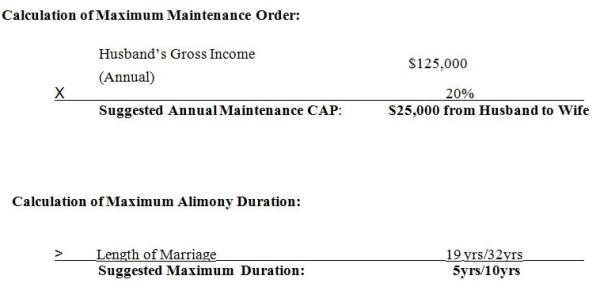
The maximum amount of spousal support that courts may award is the lesser of $5,000.00 per month or 20 percent of the payer’s average gross monthly income. This is the maximum amount of maintenance the court orders.
However, in all circumstances, the law provides that the Court shall order maintenance for the shortest reasonable period that allows the recipient to earn sufficient income to meet his or her “minimum reasonable needs” and as follows:
The Texas law mandates the maximum duration of support as follows:
Maintenance shall be paid for a maximum of:
• 5 years, if due to family violence conviction and marriage is under 10 years;
• 5 years, if marriage is between 10 and 20 years;
• 7 years, if marriage is between 20 and 30 years;
• 10 years, if marriage is 30 years or more;
except in the case of an incapacitating physical or mental disability, in which case the award may last as long as the disability.
In addition, the law allows the Texas Family Law Courts to terminate maintenance if the recipient “cohabits with another person in a permanent place of abode on a continuing, conjugal basis.”
Sample Calculation of Texas Spousal Support Maintenance:

Children in Distress: What to Do When You Need Emergency Relief
The right to obtain physical possession of a child, the right to obtain temporary relief without prior notice to the other party, and the right to exclude a party from a residence are all special circumstances in which emergency relief may be requested.
A writ of attachment is a court order requiring a child be produced at a particular location at a particular time. It is used in situations where a party is entitled to possession of a child under a court order. It may also be used when an emergency exists and a child is in imminent danger to his or her physical or emotional welfare.
The remedy is extraordinary. As such, specific facts must be alleged to command the court to issue the writ. The writ should be requested only when necessary to protect the welfare of the child.
Section 105.001 of the Texas Family Code provides the court may not render an order, except on a verified pleading or an affidavit which (1) attached the body of a child; (2) takes the child into the possession of the court or into the possession of a person designated by the court or (3) excludes a parent from possession of or access to a child.
Requests for writs of attachment are contained in petitions, motions and applications in suits affecting the parent child relationship and are filed ancillary to other requests. The court must then make a determination as to whether the necessity exists for the writ and the applications are in proper order.
The court issues a writ commanding any sheriff or constable to attach the body of a child and deliver the child to a designated place. That designated place is a location specified by the court who may command that the child be brought to the court or the court may provide a location where the child may be delivered by law enforcement.
Habeas corpus actions are brought when a party claiming a right to possession of a child is seeking the court’s help in getting the child physically turned over to that party. The court shall compel return of the child to the person filing the habeas corpus only if the court finds that the filer is entitled to possession under the order.
If the court fails to compel return of the child, the court may issue temporary orders if a suit affecting the parent child relationship is pending. The court may issues such temporary orders only if the suit affecting parent child relationship is pending and the temporary hearing is set at the same time as the habeas corpus hearing. The court may then enter an order if a serious immediate question concerning the welfare of the child is shown at the temporary hearing.
The court has defined “serious and immediate question” to mean imminent danger of physical or emotional harm that requires immediate action to protect the child. If a right to possession is established, the exception to granting the writ occurs when a serious and immediate question concerning the welfare of the child exists. If the writ is denied after the right to possession under a prior court order is established, the Texas Supreme Court requires the trial court issue a written temporary order containing a finding that there is a serious and immediate question concerning the child.
A serious and immediate question, although often alleged, is rarely found in habeas corpus actions.
A temporary order, when entered, should not be a final adjudication of custody. At a minimum, the temporary order should contain the filer’s temporary rights to possession and should set a further hearing.
Need help with an emergency relief order ?
Call us, we can help!
Nacol Law Firm
(972) 690-3333
Dallas Child Custody Attorneys
NACOL LAW FIRM P.C.
8144 Walnut Hill Lane
Suite 1190
Dallas, Texas 75231
972-690-3333
Office Hours
Monday – Thursday, 8am – 5pm
Friday, 8:30am – 5pm
OUR BLOGS

SEARCH
JOIN OUR NETWORK

Attorney Mark A. Nacol is board certified in Civil Trial Law by the Texas Board of Legal Specialization