Mediation : Alternative Dispute Resolution
“Mediation” is a process to aid parties in finding a fair and equitable settlement of disputes without unnecessary court intervention. Most Texas district and county courts require pretrial mediation for a variety of cases in order to help the parties resolve their problems while avoiding extensive court procedures and expenses
Mediation is a process in which the parties, under the guidance of a Mediator, agree upon a legally binding settlement the disputes in issue without a trial. Meditation can take many forms and the process may produce creative solutions without the direct rulings of the court. Courts usually encourage the opposing lawyers to first mediate a dispute and if no progress is made then continue the normal judicial process.
The Mediator that helps bring both sides to an agreement usually is a lawyer, ex-judge, or other specialist who has experience or expert training in the specific areas related to the dispute. A Mediator fees may range anywhere from $160-$500 dollars an hour depending on the case and the complexity of the issues in dispute. Mediators attempt to work with each side to find a reasonable middle ground to which a fair agreement can be structured.
An experienced lawyer is a valuable tool to advance favorable terms of any agreement during a mediation. During a mediation a Mediator will likely place the parties into separate “Caucus” areas, splitting the parties into different rooms to negotiate individually with each party to understand the positions and interests. Once the Mediator has talked to each party he will attempt to discover a common grounds that will fairly or smoothly serve both parties’ interests. If an agreement is reached that neither side is overly happy about, it is often likely that a reasonable compromise has been reached.
The important point of a mediation is to express your concerns and attempt to reach a compromise that is mutually acceptable, smart and fair to both sides. Many courts support this type of dispute resolution because it frees up the courts dockets and allow the parties to consider compromise first without involving the courts. Mediation maybe a cost saver, as the dollars you spend on an attorney for trial can be reduced significantly if a compromise is reached.
Make sure you have an attorney who is experienced in the Mediation process and knows how to craft a smart, fair deal which will result in significant cost savings.

The Duties Of An Executor of A Texas Will
The executor (female: executrix) is the person appointed in the will of a decedent, to administer the decedent’s estate. The Executors’ main duty is to administer the estate of the decedent, according to the terms of the will unless otherwise directed or permitted by the court.
The executor must be eighteen years older and have no prior felony convictions. Executors are usually family members or friends, accountants or lawyers. The duties of the executor start at the time of death and finish when the last state and federal taxes are paid and the estate is closed or otherwise fully disposed.
Executor responsibilities include:
-
Location and valuation of assets in the decedent’s estate
-
Preparation of an inventory of the estate’s assets
-
Payment of estate liens and debts
-
Paying administration expenses
-
Paying taxes owed by the decedent or by the estate (including tax returns)
-
Final distribution of assets to the beneficiaries after all debts, expenses, and taxes are paid.
Final distribution of the assets will be distributed according to the will. If there was no will, distribution will go according to the law of interstate succession.
An executor has legal fiduciary responsibilities and must act with utmost honesty, impartiality, and scrupulousness on behalf of the deceased and the estate’s beneficiaries. Rational decisions must be made; and the executor must overcome emotion caused by loss and adhere to the terms of the will.
Some questions the potential executor should ask before accepting the position?
-
What type of property and debts does the deceased own or owe? What type of property is it? Real estate, personal, mineral, oil or gas rights or other types of property?
-
Where is the property located? Is all the property in Texas or are some estate assets in other states?
-
Did the deceased own a business that will have to be assumed by the executor to continue operations until the probate is settled and where is the business located? The executor will need to know about all aspects of the business operations and obligations.
-
Do you have an accountant, attorney or other professional advisor who can assist you in handling the probate transition in a timely and expedient fashion?
-
What are the deceased debts? Is the estate solvent or insolvent? Are there any outstanding lawsuits or potential problems? Any other property disputes?
-
Were children born to or adopted by Decedent after the will was made?
-
Any potential family disputes?
-
Where is the will located? If the maker of the will is living, should any changes be made to the will before the person dies? If the executor decides to accept the position, does the will need to be changed on acceptance to appoint the executor of choice.
-
What are the basics of administering the executor’s position and duties while administrating of the estate of the deceased?
-
Collection and management of the assets
-
Paying all taxes, debts, and expenses of the estate
-
Distribution of remaining assets to the beneficiaries of the estate in strict accordance with the will terms.
The executor’s position can be very complicated and time consuming and you should have knowledge of all financial and legal aspects of probating an estate. An experienced employee, accountant or attorney can help you with this important task. If not sure, ask for help! You have a serious and legally accountable responsibility to the estate and its beneficiaries.
Holding an Inspector Accountable When Purchasing a Home
The housing market has exploded in the Dallas / Ft. Worth area in the last several years through the move of many companies to relocation national/regional headquarters to Texas. New jobs have created an explosion in the DFW housing market bringing in many potential buyers. A nice home in a good neighborhood may last only a couple of days before it is sold.
Potential buyers must be prepared when purchasing a home in the Lone Star State. After the initial offer, it is customary to have 8-12 days for a potential buyer to have the prospective home inspected by an independent third party. During this time, it is important to find an inspector that you trust.
If the home inspector performs a negligent inspection or misrepresents the condition of a part or a defect in the home that causes expensive problems for the buyer, the inspector may be liable. The Texas Deceptive Trade Practices Act (DTPA) will protect a buyer from the misrepresentation of an independent inspector. Under the DTPA per Tex. Bus. & Comm. Code §§ 17.46(b) there are multiple causes of action to insure your protection if an inspector committed an action that:
(a) represented that goods or services are of a particular standard, quality, or grade, or that goods are of a particular style or model, if they are of another;
(b) causing confusion or misunderstanding as to the source, sponsorship, approval, or certification of goods or services;
(c) causing confusion or misunderstanding as to affiliation, connection, or association with, or certification by, another;
(e) representing that goods or services have sponsorship, approval, characteristics, ingredients, uses, benefits, or quantities which they do not have or that a person has a sponsorship, approval, status, affiliation, or connection which he does not;
(f) representing that goods or services are of a particular standard, quality, or grade, or that goods are of a particular style or model, if they are of another;
(g) knowingly making false or misleading statements of fact about the need for parts, replacements, or repair service;
(h) falsely representing that work or services have been performed on or parts replaced in goods; and
(i) failing to disclose information concerning goods or services which was known at the time of the transaction if such failure to disclose such information was intended to induce the consumer into a transaction into which the consumer would not have entered had the information been disclosed;
These are some of the causes of actions that can be filed against a home inspector that misrepresented a portion of the home that had a severe defect. DTPA actions can be complex and intricate both in filling the action and in litigation of the case. An experienced real estate attorney is needed if you wish to pursue a remedy.
Julian Nacol, Attorney
Nacol Law Firm P.C.

Texas Divorce / Texas Child Support Q and A
Q: How long is the divorce process?
A: In a Texas divorce there is a waiting period of a minimum of 60 days from the time you file the Original Petition commencing the lawsuit to the time the divorce may be finalized. Few divorces are finalized in this time-period. It is more likely that an uncontested divorce will take approximately 3 to 6 months and a contested divorce will likely will take much longer depending on the issues and conduct of the parties.
Q: Do my spouse and I both have to hire attorneys?
A: No. But it is certainly in your best interest to hire an attorney for a consultation purposes and to review legal documents for your own protection. An attorney should not in the vast majority of cases represent both parties, so if one attorney is involved he or she will under law be looking out for the best interest of the client that hired him/her, while the other party is representing themselves (pro se).
Q: Will I have to go to court?
A: If the spouses reach agreement, one party will have to appear in Court. Often times, when the parties have worked out their own settlement, that agreement is signed by each of you and submitted to the court with only one party making a personal appearance to state to the Court that the agreement has been reached and to establish statutory requirements. If, on the other hand, you and your spouse cannot come to an amicable settlement through this process, you will both have to appear in court, and often on many occasions.
Q:Should I Move Out of the Marital Residence?
A: Be sure to consult with an attorney before leaving the marital residence. Leaving the home may be viewed as abandonment or actually declaring a new residence, especially if you are taking personal items with you (clothing, automobile, sentimental possessions, etc.). If children are involved issues may arise as to who currently has or should have primary possession of the children. Once you have voluntarily left the home, it may be difficult to move back in or obtain orders for primary or temporary possession.
Q:How Do I Get a Divorce?
A: Before getting divorced you or you and your spouse should decide that you absolutely want and need the divorce. Even though in the divorce process prior to final judgment everything is reversible, it is important that you realize that the road is sometimes very long and can be a difficult one to travel.
Q:What if I Do Not Want a Divorce?
A: The advent of a divorce is something that slowly builds. You may want to consult with your spouse about placing things on hold while you receive counseling. However, the need for a divorce is rarely something that happens over night. Your spouse may have made his or her mind up long ago that divorce is the only option. If your spouse has filed for divorce, you have no choice. The most important thing for you to do if your spouse has filed for divorce is promptly seek proper legal advice.
If your spouse has significant assets and you feel they may be considering divorce seek legal advice immediately. You may want to do some pre-planning to make sure you have complete copies of original and final documents and know where all the marital assets are located and to assure their status. Do not give your spouse time to stash, spend away and/or hide assets.
Q:Can You Modify Child Support Orders?
A: Making changes to an existing child support order is not uncommon. Most states will not allow a request for modification on a child support order unless a time-period (of 2 to 4 years depending on the state) has passed since the order was put into place. Keep in mind that child support orders cannot be increased or decreased on a whim. In Texas, you must show a change in circumstances. However, if the person paying child support’s income has gone up or down more than 25% you can request a change. IMPORTANT NOTE: If you agree to no child support in your first order (Final Decree) and your spouse has a significant income at that time, you may have waived a statutory right to future child support unless the income level at the time of the existing order increases or decreases significantly.
Q:Can I Deny My Ex-spouse Visitation, Possession or Access?
A: You can not and should not deny visitation or possession, unless the Court has modified the visitation or possession to allow it! Denying visitation or possession is one of the biggest mistakes made by most primary custodial parents – it is an act of contempt in Texas. You may believe you have a justifiable reason for denying the visitation or possession rights, but by law your are not permitted to do so absent extraordinary circumstances, usually involving gross neglect or physical abuse.
Q:How Do I Get Custody of My Child(ren)?
A: The first and most important step to getting custody of your child(ren) is to be an involved and hands-on parent and to be honest. Being a great parent is not always the easiest task during divorce, but it is important to carefully consider each and every action you take during a divorce and how it may or may not effect the child(ren). You will also need good legal representation. Child custody issues can become ugly and complicated no matter how good your intentions may be. Make sure you are prepared. Document everything.
Q:What if I Do Not Like the Judges Decision?
A: The purpose of the ruling is to establish what exactly should be stated in the Final Divorce Decree. Once the attorneys have drafted the Final Divorce Decree and both parties have agreed that it coincides with the ruling, it will be presented to the Judge for signing. Once the parties have agreed and signatures are signed, you will have to live with the decisions. If the divorce is highly contested and the Judge rules and you are unhappy with the results, you have only a small window to appeal the decision or request a new trial.
Q:What is Fair Spousal Support or Alimony?
A: If you and your spouse can not come to agreement on the need for or amount of spousal support to be paid, the length of time, and under what conditions, the spousal support will most likely be set by a Judge according to Texas law.
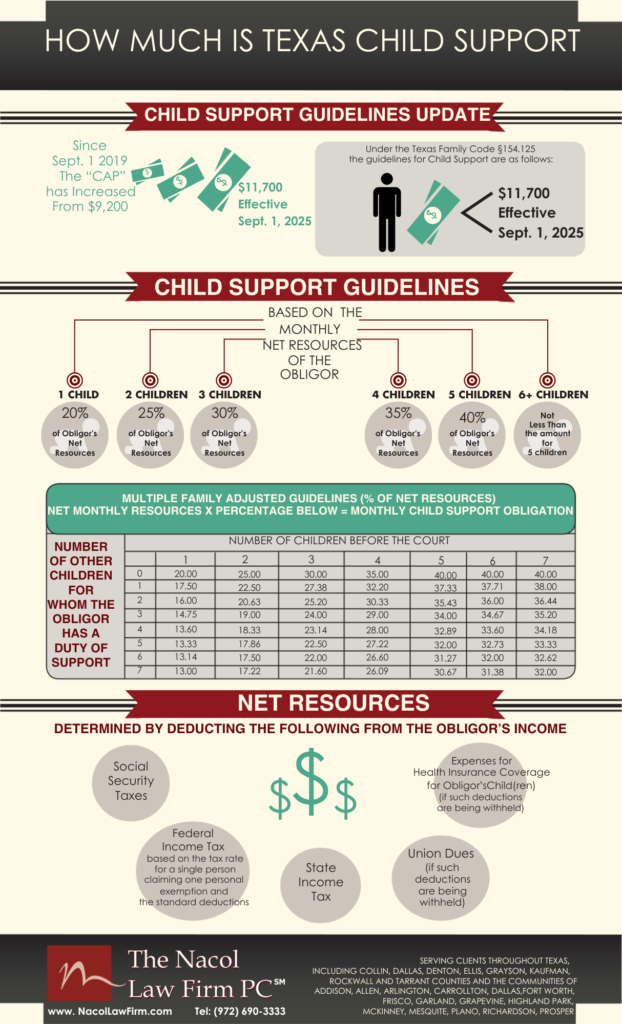
Q:How Much is Child Support?
A: See Graphic below and also read our blog on Texas Child Support Guidelines
Dallas Divorce Attorney
Julian Nacol
Nacol Law Firm P.C.
Call (972) 690-3333
High Asset Divorces: Separate Property Real Estate and Trusts
It is important to know what happens to your homestead residence if it was purchased prior to marriage and other assets formed into a trust before marriage without a prenuptial agreement.
- Separate property homestead residence
Single most important event for leverage is who files their Divorce Petition first. If you file first, you are a Petitioner. A Petitioner receives a crucial benefit in litigation. A petitioner is afforded the opportunity to talk first and last in litigation, sets the tempo of the divorce, and creates the narrative of the divorce. Being a Petitioner is invaluable, thus if you have decided that you need to divorce your spouse, you should look to file the divorce petition first.
Temporary Orders are usually, absent emergency relief, the first hearing the Court will have in the case. At temporary orders the Judge will likely attempt to (1) place a band-aid on all assets of the marriage to ensure there is no wasting of assets, (2) determine custody and access of the children, and (3) ensure payments remain the same towards any separate or community property assets. Temporary spousal maintenance, exclusive use of property, and injunctions are granted at this hearing. In a divorce with high value assets this hearing is pivotal in determining how litigation will continue in the future. Every Court is different but multiple additional temporary order may be filed or clarification motions to ensure that the children and property of the divorce are protected.
2. Discovery Phase and Experts
The discovery phase may be cumbersome and painful. Discovery consists of multiple written questions that one spouse is asking the other during the divorce litigation. These include production questions (asking for documents), interrogatories (questions require a written notarized responses), admissions (admit or deny questions), depositions (typically 6 hour cross examination in front of court reporter at an attorney’s office), and inventory and appraisal (sworn list of assets and values of each asset). These processes are usually expensive but necessary to prove the amount of the marital estate and the characterization of property.
Experts are also employed at this stage. They are costly but necessary to prove tracing, the value of any potential fraud against martial property, or the overall value of a business that one spouse may own. These issues are likely contested, thus the battle of experts continue until the final hearing.
3. Depositions
A deposition is a formal question-and-answer session used in divorce cases to gather information under oath before going to trial in a case. It typically takes place in a lawyer’s office, where one spouse (the deponent) answers questions from the opposing attorney while a court reporter records everything. The purpose of a deposition is to uncover facts, clarify disputes, and assess how a witness may testify in court. While it doesn’t happen in a courtroom, the statements made during a deposition carry legal weight and can be used as evidence later. Depositions can sometimes be a total of 6 hours of questing the deponent.
During a deposition, attorneys may ask about finances, assets, parenting abilities, or any issues relevant to the divorce. It’s a structured process, but it can feel intense—especially if the other lawyer is trying to challenge credibility or uncover hidden details, such as finding additional martial assets. Being honest and composed is key, as misleading answers can backfire. Having an attorney present helps ensure that questions are fair and objections can be made when necessary. While depositions may seem intimidating, they are a valuable tool in ensuring transparency and helping both sides prepare for a fair resolution.
4. Mediation
Meditation may occur in the middle or toward the end of the litigation process. The cost of a good mediator may range from $2,000.00 to $3,500.00 per side. The mediation process can be difficult and last from a half day (4 or so hours) to more than a full day. Some mediations go for 14 to 15 hours to obtain settlement. Though this is expensive, it is still less costly than going to a final trial and many outcomes or solutions may be obtained by agreement of the parties to which a Judge cannot order. The flexibility of mediation makes this process less painful and costly than attending a final trial.
5. Final Trial before the Court or Jury
Final trial may be performed solely by a Judge or a Jury of 12 peers. Only 10 of 12 Jury members are needed to find in favor of either party. A Jury trial is more expensive, takes more time to prepare, and may be more risky depending on the County and facts of each specific case. A trial before the Judge is cheaper and may simplify many matters. It is important to know for every 1 hour in Cout it takes more or less 4 hours to prepare.
A jury trial with a minimum of 2 experts and multiple other fact witnesses should take anywhere from 4 to 7 days. A trial before the Judge for a similar case may take 2-4 days, depending on how the Judge runs the Court.
There are many trials and tribulations an individual will have to surpass in the Court system if they are divorcing with high assets. It will likely be costly, painful, but necessary. Many other factors such as summary judgements or motions to exclude witnesses, experts, or exhibits, may increase fees. It is important to be confident with your attorney and find a firm that has experience with higher assets cases to ensure the flow and strategy of the litigation fulfills your goals.
Dallas High Asset Divorce Attorneys
Nacol Law Firm P.C.
(972) 690-3333
NACOL LAW FIRM P.C.
8144 Walnut Hill Lane
Suite 1190
Dallas, Texas 75231
972-690-3333
Office Hours
Monday – Thursday, 8am – 5pm
Friday, 8:30am – 5pm
OUR BLOGS

SEARCH
JOIN OUR NETWORK

Attorney Mark A. Nacol is board certified in Civil Trial Law by the Texas Board of Legal Specialization