The Pitfalls of Pro Se Representation
Pro se is a Latin term meaning “for oneself” or “on one’s own behalf.” To represent oneself pro se means to advocating for one’s own self before a court, rather than being represented by counsel. The right of a party to a legal action to represent his or her own cause has long been recognized in the United States, and even predates the ratification of the Constitution. But is this the wisest course of action?
According to National Center on State Courts, 71% of domestic relations (family law) cases have at least 1 unrepresented party. In 18% of cases both parties are pro se litigants. So where does the problem lie when a litigant decides to walk into a courtroom without proper legal representation? The simple fact is that the vast majority of pro se defendants lose their cases.
The following is a quote from a judge used against a Defendant who represented himself after murdering his girlfriend. “You don’t know how to ask a question…You don’t know how to offer things into evidence. You keep making stupid speeches. You keep saying you are good at this. You are not… I do not say this to insult you…You do not know the law.”
What’s important to highlight from the judge’s speech is that it really underscores the greater reason why it is tough for a party to represent themselves in court. Poor representation is likely to antagonize a judge. Being a lawyer in the United States requires a vast amount of knowledge regarding proper legal rules and court procedures. Areas of knowledge like the federal rules of evidence, state rules of civil procedure, and local rules of court are generally very foreign and unnatural concepts to a pro se litigant. However, these were created for reasons of fair, speedy, and efficient justice.
The justice system is designed, in large part, for the traditional full representation model. Virtually all aspects of the system, from the rules to the training of judges and court staff to the physical layout of the courthouses themselves, have been oriented to cases in which knowledgeable attorneys represent the parties. The ability of a party to proceed without an attorney in prosecuting or defending a civil action is largely a matter of state law, and may vary depending on the court and the positions of the parties.
Pro se appearances may delay a trial proceeding and enhance the possibility of a mistrial and a subsequent appeal. Pro se litigants are not entitled to an award of attorney’s fees. However, a Court may order a pro se litigant to pay the attorney’s fees for the opposing party.
In some instances, pro se representation is not allowed. A pro se litigant may not represent a corporation, as a corporation is considered a “person” separate and distinct from its officers and employees. A non-lawyer may not sign and file a notice of appeal on behalf of a corporation. Similarly, a pro se litigant may not act as a class representative in a class action proceeding. In other words, a pro se litigant may not bring a class action lawsuit.
Another situation in which appearance through counsel is often required is in a case involving the executor or personal administrator of a probate estate. Unless the executor or administrator is himself an attorney, he is not allowed to represent himself in matters other than the probate.
Few federal courts of appeals allow unrepresented litigants to argue, and in all courts the percentage of cases in which argument occurs is higher for counseled cases.
Legal forms are becoming increasingly available on-line. However, numerous problems arise when deciding to use online forms and services. More often than not, these services do not take into account specific state laws. Only an attorney authorized to practice law in a specific state can effectively advise a party regarding the various jurisdictional issues that may affect their case. Many states have varying requirements when it comes to witnesses, discovery, case experts, and specific language that must be included in legal forms. Failure to comply with state requirements may lead to a case being dismissed by the court and increase future litigation expenses.
While a party has the right to represent themselves pro se in a court of law, they should not expect any special treatment, help, or attention from the court. And enough importance cannot be placed on the fact that they must comply with the Rules of the Court, even if they are not familiar with them.
Perception is everything. Representing oneself pro se can send out all the wrong signals to a judge and/or jury: that a party is not taking the matter seriously, determined to be obstructive, penny-pinching, unwilling to compromise, believe they are right and cannot maintain a proper relationship with counsel, or just downright difficult. Is this really the impression you want the court to have?
It will probably come as no surprise that the most common excuse for not employing a lawyer is that one cannot afford it. That may be short sighted. A good lawyer ought to be able to achieve a result that is fairer and of better value than a litigant struggling to do so on their own. Add to that the possibility that failure to understand and comply with court orders may result in orders for costs being made against the pro se party and the numbers start to mount up. It’s also the lawyer’s job to try to broker a settlement in order to avoid the expense of protracted proceedings and a costly trial. Trying to negotiate a settlement without proper legal counsel may end in disaster.

High Asset Divorces: Separate Property Real Estate Q&A
It is important to know what happens to your homestead residence if it was purchased prior to marriage and other assets formed into a trust before marriage without a prenuptial agreement.
Question: If an individual has a prior separate property residence, does the individual retain all interest in their property.
Answer: Yes, the separate property owner shall retain all interest including increase in value but certain exceptions apply.
Exceptions such as reimbursement claims for time, toil, and effort, payment of debt, and improvement of property may be granted to the spouse as an offset or an award. One example is if the community property income during the marriage paid down the note of the separate property, then the spouse shall be entitled to ½ of the equity paid during the time of the marriage, but not the interest paid.
Question: If an individual gets divorced can the Court force sale his separate property?
Answer: Generally, no. If the property is a homestead then there is an added protections. A court generally cannot force partition another individuals property, but there the years there have been multiple exceptions to which trial judges attempt to infringe on an individual’s separate property rights.
First, if property is purchased prior to marriage it likely be classified as separate property. The owner of the house must insure that during the marriage the individual does not place the spouse on the properties deed, nor refinance the house with the house. If an individual does this be costly, painful, but necessary. Many other factors such as summary judgements or motions to exclude may increase fees. It is important to be confident with your attorney and find a firm that has experience with higher assets cases to insure the flow and strategy of the litigation fulfills your goals.
Question: How can I protect my separate property residence from forced sale or other exception to all separate property owner retaining equity?
Answer: A separate property marital owner can protect the separate property residence by entering into a prenuptial or postnuptial agreement.
A prenuptial agreement is a legally binding contract signed before marriage outlining how assets, debts, and spousal support, if any, will be handled in case of divorce or death. A postnuptial agreement is similar to a prenuptial agreement but is signed after the marriage.
A separate property residence should be identified in a prenuptial or postnuptial agreement in order to protect the rights of the separate property owner.
Dallas High Asset Divorce Attorneys
Nacol Law Firm P.C.
(972) 690-3333

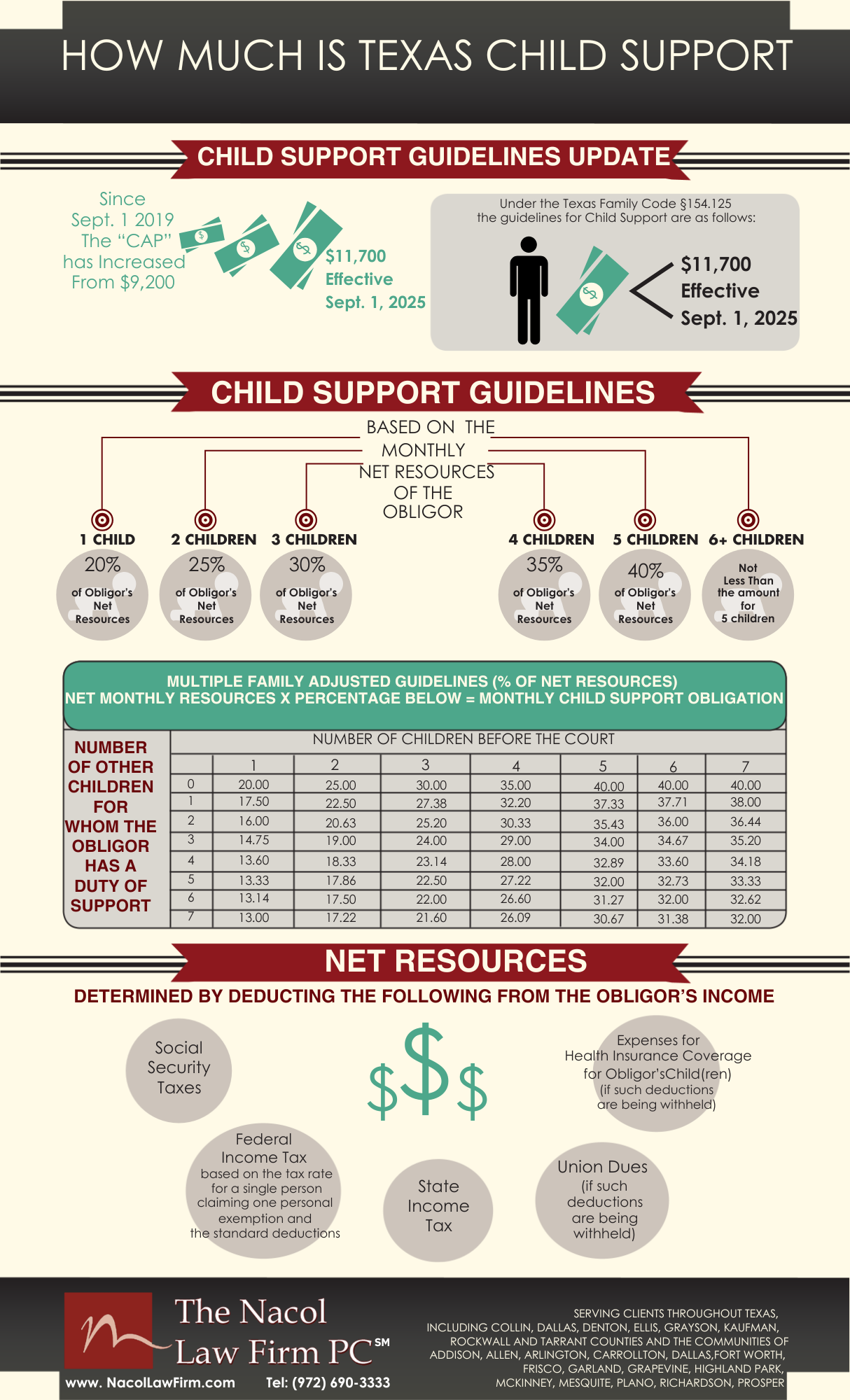
Texas Child Support Guidelines
UPDATE ON TEXAS CHILD SUPPORT:
A new cap is effective for all child support orders finalized on or after September 1, 2025
The Texas child support cap increased from $9,200 to $11,700 in net monthly resources for orders finalized on or after September 1, 2025, following legislative changes to the Family Code. This significant adjustment, part of the regular Texas child support guideline review, means higher guideline support amounts for higher-income parents. For example, the new cap results in a maximum monthly payment of $2,340 for one child (20% of $11,700) and up to $4,680 for five or more children (40% of $11,700) under the standard guideline framework.
Texas Family Code §154.125(a)(1) requires that every six years the presumptive amount of net resources to which the child support guidelines apply shall be reviewed and adjusted for inflation by the Texas Office of the Texas Attorney General (OAG). That section sets out the formula for doing so based on the consumer price index. The last adjustment was done in 2019 when an amount of $9200 per month was established.
How does the “cap” work and what could this mean for you? If your net monthly resources are less than $11,700, the child support obligation will not change on Sept. 1. You are under the “current cap” and lower than the “new cap”. All stays the same.
If you are currently going through litigation and your net monthly resources exceeds $11,700 and the Court orders child support prior to September 1, 2025, Texas Child Support Guidelines will mandate that the Court apply the appropriate child support percentage to the first $9,200 in net monthly resources based on the number of children. But, if the Court orders child support after September 1, 2025, it will apply the new appropriate child support percentage to the first $11,700 in net monthly resources.
Child support under the guidelines is determined by applying the applicable percentage, beginning at 20% for one child and increasing incrementally for each additional child, to the net resources amount. If a child support obligor has monthly net resources over $11,700, a party seeking above the guideline’s child support has the burden of proving to the court that additional support should be ordered according to factors set out in Texas Family Code §154.126.
Important to Know: The new “cap” increase of September 1, 2025 will not automatically increase the obligor’s existing child support obligation. Any change in child support standing before September 1, 2025, can only occur through the court with a modification order to increase the child support to the new “Cap” amount of $11,700. After September 1, 2025, any new suit for child support will be subject to the new “cap”.
Please review the Texas Office of the Texas Attorney General (OAG) website for a child support calculator for the new breakdown: https://csapps.oag.texas.gov/monthly-child-support-calculator
The Nacol Law Firm PC
8144 Walnut Hill Lane
Suite #1190
Dallas, Texas 75231
Nacollawfirm.com

Will Contest
The requirements for testamentary capacity are minimal. Some courts have held that a person who lacks the capacity to make a contract can still make a valid will. While the wording of statutes or judicial rulings will vary from one jurisdiction to another, the test generally requires that the testator was aware of:
• The extent and value of their property
• The persons who are the natural beneficiaries
• The disposition he is making
• How these elements relate to form an orderly plan of distribution of property.
The legal test implies that a typical claimant in a will contest is a disgruntled heir who believe he should have received a larger share than what he received under the will. Once the challenging party meets the burden of proof that the testator did not possess the capacity, the burden subsequently shifts to the party propounding the will to show by clear and convincing evidence that the testator did have the requisite capacity.
Duress or coercion (as a term of jurisprudence) is a possible legal basis to set aside or otherwise modify a will, in that, the execution of the will by the Testator/Testatrix arises out of an immediate fear of injury. Black’s Law Dictionary (6th ed.) defines duress as “any unlawful threat or coercion used… to induce another to act [or not act] in a manner [they] otherwise would not [or would].”
To establish duress, four requirements must be met:
• Threat must be of serious bodily harm or death
• Harm threatened must be greater than the harm caused by the crime
• Threat must be immediate and inescapable
• The defendant must have become involved in the situation through no fault of his or her own
A person may also raise duress when force or violence is used to compel him to enter into a contract, or to discharge one.
Depending on the grounds, the result may be:
• Invalidity of the entire Last Will and Testament, resulting in an intestacy.
• Invalidity of a clause or gift, requiring the court to decide which charity receives the charitable bequest, using the equitable doctrine of cy pres
• Dimunition of certain gifts, and increase of other gifts to the widowed spouse or orphaned children, who would now get their elective share.
The Nacol Law Firm PC
8144 Walnut Hill Lane
Suite 1190
Dallas, TX 75231
Metro: 972-690-3333
Toll Free: 866-352-5240
Fax: 972-690-9901
www.NacolLawFirm.com

The Usefulness of a Revocable Trust
A trust can be a useful tool in disbursing your estate during and after death. It is hard to consider one’s mortality but when you do finally accept that death is inevitable, it is prudent to have a dispositional scheme set up that will benefit your family. A Revocable Trust is a less complicated and more expeditious way for your heirs to divide and distribute your estate according to your own specific plan once you have passed.
A Revocable Trust is a legal entity created by an individual that is used to disburse an individual’s estate avoiding significant probate court involvement. The Settler is the individual who sets up the trust and places limitations on what the trust can or cannot do with trust assets. The Trustee is the person in charge of the trust and who has a fiduciary duty to the Settlers and Beneficiaries to distribute the estate in accordance with the limitations set forth by the Settler. The Settler, in some instances, may be the Trustee as well. A Settler may not be the beneficiary of a Trust.
A Settler may also be the Trustee and is given the power to change the trust in many ways. Under Texas Property Code 122.033 a Settler that is also the Trustee reserves such powers as:
- Making a beneficial life interest for himself;
- The power to revoke, modify, or terminate the trust in whole or in part;
- The power to designate the person to whom or on whose behalf the income or principal is to be paid or applied;
- The power to control the administration of the trust in whole or in part;
- The right to exercise a power or option over property in the trust or over interests made payable to the trust under an employee benefit plan, life insurance policy , or otherwise; or
- The power to add property or cause additional employee benefits, life insurance, or other interests to be made payable to the trust at any time.
The important point is that Texas allows an individual to both make a trust and control the Trust.
A Revocable Trust can used to bypass the court system thus producing a quick and effective means for an estate to be disbursed. Instead of probating a will and having the court get involved which is timely, an individual may create a trust with limitations which can bypass the court process altogether.
The creation of a Trust can be a complex process depending on the size of the estate. An experienced estate lawyer should be consulted to ensure the Settler’s limitations set upon the Trust are valid and precise. By utilizing a Trust rather than a Will or Intestate Succession, an individual can avoid undue delay in probating the estate and the Trust itself allows the Settler the ability to specify the exact conditions and limitations that will be involved as the estate is disbursed.
NACOL LAW FIRM P.C.
8144 Walnut Hill Lane
Suite 1190
Dallas, Texas 75231
972-690-3333
Office Hours
Monday – Thursday, 8am – 5pm
Friday, 8:30am – 5pm
OUR BLOGS

SEARCH
JOIN OUR NETWORK

Attorney Mark A. Nacol is board certified in Civil Trial Law by the Texas Board of Legal Specialization