
Texas Cohabitation and Domestic Partnership Agreements for Boomer and Senior Couples
Premarital and post-marital agreements in Texas have a complex history immersed in the community property presumption, the state constitution, statutes and case law. Originally, such agreements were found to be unenforceable. But with amendments to the Texas Constitution, evolving statutes, recent case law, and improved draftsmanship, such agreements are now enforceable under contract law.
For many Boomer and Senior couples, living together is a precursor to marriage; for others because of family issues or commitments, there is no intent to ever marry. The simple fact is, domestic partnership agreements address a wide variety of circumstances, many involving established adults who want to be together but because of prior financial and family commitments prefer to have an applicable contractual agreement for their legal needs.
Many couples choose to live together so they do not lose certain benefits under current rules of social security, military and insurance disability programs, or to stop those benefits from being taken away from their children. In other cases, couples who are divorced, and who may have children, may want to protect certain assets. In situations such as trust funds or inherited funds, beneficiaries simply do not want to place family money at risk. Other couples choose to shelter their own resources from the real or perceived obligations of their partner.
The marital agreement is considered to be a contract under Texas law. The premarital agreement must be in writing and signed by both parties. No actual consideration is required; however, to conform to contractual law, it may be wise to provide benefits for the non-monied party to avoid a later finding of unconscionably, particularly if the financial or physical condition of the non-monied party under the agreement is poor.
Matters that may be dealt with in a premarital agreement include, but are not limited to, the following:
- the right to buy, sell, use, transfer, exchange, abandon, lease, consume, expend, assign, create a security interest in, mortgage, encumber, dispose of, or otherwise manage and control property;
- The rights and obligations of each of the parties in any of the property of either or both of them whenever or wherever acquired or located;
- The disposition of property on separation, marital dissolution, death, or the occurrence or nonoccurrence of any other event;
- The modification or elimination of spousal support;
- The making of a will, trust, or other arrangement to carry out the provisions of the agreement;
- The ownership rights in and disposition of the death benefit from a life insurance policy;
- The choice of law governing the construction of the agreement; and
- any other matter, including their personal rights and obligations, not in violation of public policy or a statute imposing a criminal penalty.
In post-marital agreements, it has been noted that a fiduciary duty exists that is not present in pre-marital agreements between spouses or prospective spouses. Case law states that a confidential relationship between husband and wife imposes the same duties of good faith and fair dealing on spouses as required of partners and other fiduciaries. However, adverse parties who have retained independent counsel may not owe fiduciary duties to one another. Texas Legislature enacted Section 4.105 with the understanding that married spouses owing fiduciary duties to one another would negotiate and execute post-marital agreements. Notwithstanding these duties, the legislature manifested the strong policy preference that voluntarily made post-marital agreements are enforceable.
Beside a Cohabitation and Domestic Partnership Agreement, what other documents should you supplement for a more complete legal coverage?
- A will with a designated executor to handle execution and distribution of all assets
- A durable financial power of attorney
- A durable medical power of attorney, directive to physicians, and a HIPPAA release form
- Partnership agreement to set out and clarify property rights, define ownership and related issues upon dissolution
Cohabitation, domestic partnership, premarital and post-marital agreements may be as creative as a party determines necessary. However, care must be given to see that such agreements protect the party, keep with public policy, and adhere to current Texas family law and applicable contractual law.

New Texas Legislature Family Laws : Effective Date Sept 1, 2015
The 2015 Texas Legislature was active on family law bills and changes to the Texas Family Code! These many changes to various provisions of the family code could legally affect you and your family.
Some of the more important 2015 Family Laws, Amendments, and Revisions:
House Bill 826 amends the Family Code to require a child support order to contain a specified statement regarding the circumstances under which a court may modify a child support order. Effective: 9-1-15
House Bill 1447 amends the Code of Criminal Procedure to expand the persons authorized to file an application for a protective order for certain victims of sexual assault or abuse, stalking, or trafficking and to entitle victims of those offenses or the victim’s parent or guardian to additional crime victims’ rights relating to the protective order to provide the notice in the prescribed manner a Class C misdemeanor. Effective: 9-1-15
House Bill 1500 amends the Family Code to require a person who files a motion for a temporary order in a suit for modification of the parent-child relationship to execute and attach to the motion an affidavit that contains facts that support the allegation that the child’s present circumstances would significantly impair the child’s physical health or emotional development. The bill establishes a court’s duty to schedule a hearing if those facts are adequate to support the allegation. Effective: 9-1-15
House Bill 1782 amends the Family Code to establish, for purposes of a family violence protective order, the presumption that family violence has occurred and is likely to occur in the future if the respondent has been convicted of or placed on deferred adjudication community supervision for an offense involving family violence against the child for whom the petition is filed, the respondent’s parental rights with respect to the child have been terminated, and the respondent is seeking or attempting to seek contact with the child. Effective: 9-1-15
House Bill 1923 amends the Civil Practice and Remedies Code to include a retired or former statutory probate court judge among the judges eligible to serve as a special judge in certain civil or family law matters. Effective: 9-1-15
Senate Bill 206 amends the provisions of the Education Code, Family Code, Government Code, and Human Resources Code relating to the functions and administration of the Department of Family and Protective Services (DFPS). The bill revises and streamlines agency procedures involved in adoption cases and child protective services cases by changing various record keeping, notification, and casework documentation requirements and provisions governing the investigation of a report of abuse, neglect, or exploitation of a child and by condensing and updating provisions governing procedures in a child protection suit, including adversary and permanency hearings, and the performance of a child placement review for a child under DFPS care. The bill establishes annual reporting requirements for DFPS regarding key performance measures and data elements for child protection and sets out notification requirements relating to significant events for a child in DFPS conservatorship involving the child’s placement, medical condition, prescribed drugs, and school performance; revises provisions governing foster care, including requirements that foster children be provided access to certain personal information and documents; and sets out requirements for implementing foster care redesign. The bill consolidates and restructures provisions regarding prevention and early intervention services, including the child abuse and neglect primary prevention program, and requires the development and implementation of a strategic plan for those services within DFPS. The bill revises provisions relating to public school admission and attendance of, and eligibility for an exemption from tuition and fees for, students under DFPS conservatorship.
The bill broadens the authority of DFPS to obtain criminal history record information regarding certain persons; authorizes the executive commissioner to adopt rules regarding the purpose, structure, and use of advisory committees by DFPS; and requires the development and implementation of an annual business plan for the child protective services program to prioritize the department’s activities and resources to improve the program. The bill provides for an enforcement policy for the regulation of certain child-care facilities, homes, and agencies and revises provisions governing administrative remedies for those regulated entities.
The bill requires DFPS to study whether provisions governing authorization agreements between the parent of a child and a nonparent relative should be expanded to include authorization agreements between a parent of a child and a person who is unrelated to the child. Effective September 1, 2016, the bill updates provisions governing the licensing and certification of certain child-care facilities, homes, and agencies. Effective: 9-1-15
Senate Bill 314 amends the Family Code to detail what information the Department of Family and Protective Services and a court appointing a nonparent as managing conservator of a child must provide to the nonparent. Effective: 9-1-15
Senate Bill 550 amends the Family Code, Government Code, Insurance Code, and Labor Code to establish a court’s duty to render an order for the dental support of a child in a suit affecting the parent-child relationship or in a proceeding under the Uniform Interstate Family Support Act. Effective: 9-1-15
Senate Bill 813 amends the Family Code to establish that a digitized signature on a pleading or order in a proceeding involving the marriage relationship, the child in relation to the family, or a protective order satisfies the requirements for and imposes the duties of signatories to pleadings, motions, and other papers identified under the Texas Rules of Civil Procedure. Effective: 9-1-15
Senate Bill 814 amends the Family Code to establish the authority of a party to a suit to remove the disabilities of minority, a suit to change a person’s name, or a suit affecting the parent-child relationship to waive the issuance or service of citation. The bill revises requirements for a waiver of service in a suit for dissolution of a marriage. Effective: 9-1-15
Senate Bill 815 amends the Family Code to expand the types of activities a court may prohibit by temporary restraining order in a suit for the dissolution of marriage. Effective: 9-1-15
Senate Bill 818 amends the Family Code to require a court to order that each conservator of a child has the duty to inform the other conservator of the child of certain information regarding the conservator’s involvement with a person who is the subject of a final protective order or if the conservator is the subject of such an order. The bill establishes deadlines for providing the notice and makes a conservator’s failure to provide the notice in the prescribed manner a Class C misdemeanor. Effective: 9-1-15
Senate Bill 1726 amends the Estates Code, Family Code, and Government Code to revise and clarify provisions relating to suits affecting the parent-child relationship, including provisions relating to Class 4 claims against an estate, the conditions under which a court is authorized to order that certain information not be disclosed to a party to a suit, notice requirements regarding enrollment in or termination of benefits under an employer’s health insurance plan, and notice requirements and enforcement mechanisms for certain child support orders. Among other provisions, the bill provides for electronic notarization of required signatures in a proceeding filed under provisions relating to the parent-child relationship. Effective: 9-1-15
To view more information on the 2015 Texas family law bills, amendments, and revisions go to Texas Legislature Online @ http://www.capitol.state.tx.us/

New Family Laws in Texas : Effective September 1st 2015
Now that the Texas Legislature has ended, we will review some of the bills passed that will affect our Family Law Cases.
S.B. 814 Waivers of Citations in Certain Family Law Suits
Currently, the state of Texas allows for a parties involved in a divorce to waive service. Loosely translated, that means that the person named in the divorce suit can sign a paper which proactively tells the relevant court that they are officially aware their spouse is filing for divorce. This waiver means they don’t have to physically be served with the divorce papers by their spouse or a process server, potentially saving everyone involved a bit of time, money, and maybe some emotional pain
S.B. 814 was introduced to further the use of such waivers to apply to other common family law matters.
The waiver should also be used for:
- Suits to remove disability of a minor (commonly referred to as emancipation)
- Suits to change the name of an adult or child
- Any suits relating to a parent-child relationship
The bill passed and will take effect on September 1, 2015.
S.B. 817: Issuance of a protective order and appointment of a managing conservator in certain family law proceedings.
S.B. 817 proposes that the state change the language on applications for protective orders (restraining orders, etc.) by switching the word “victim” with the phrase “applicant for a protective order.” Specifically, this change is meant to help those people who are applying for the protective order on behalf of the actual victim of the abuse or violence.
Some judges are currently reluctant to sign orders which list the applicant as a “victim” because doing so indirectly endorses the allegations of abuse as being true without a trial. With the label change, it removes that concern and will enable judges to issue more orders to protect those in need.
The bill passed virtually unopposed, and will take effect on September 1, 2015.
S.B. 314: Appointment of a non-parent as managing conservator of a child.
This law addresses a growing number of complaints by relatives who assume custody of children removed from their parents’ homes by CPS (Child Protective Services). This type of custody is called “permanent managing conservatorship,” or PMC. It is not adoption and does not carry the same legal meaning, but many relatives claim that these differences are not clarified by CPS.
As a result, the bill requires a court awarding custody to specifically explain 3 common misunderstandings to the relatives or non-parents assuming PMC.
- PMC rights are specified by the court, and are not the same as rights associated with adoption
- The parent(s) can still request visitation, and can request to become the managing conservator
- PMC does not qualify nor disqualify the relative or non-parent for/from post-adoption benefits
The bill states that if the non-parent assuming PMC does not appear in court, the court must then have evidence that they were advised of this information.
The bill passed without opposition, and will take effect on September 1, 2015.

Business Contracts in Texas
A contract is defined as a promise or set of promises with legal consequences. Normally, contractual promises are enforceable in a court of law. The law gives official recognition of the written contractual promises and offers remedies when the promises are not fulfilled.
The Supreme Court of Texas has noted that every contract includes an element of confidence and trust that the parties will faithfully perform their obligations. There is no duty of good faith and fair dealing unless the duty is created by express language in the contract or a special relationship of trust and confidence exists between the parties to the contract.
In Texas, the requirements for a valid written contract are:
1) an offer;
2) an acceptance in strict compliance with the terms of the offer;
3) a meeting of the minds (which is actually a subpart of the accepted elements, not an independent element;
4) each party’s consent to the terms;
5) consideration; and
6) execution and delivery of the contract with the intent that it be mutual and binding.
A basic element of the contract is the promise, which may be an express or implied promise made by one party for the purpose of assuring another person that a particular action or restraint from a particular action will occur. This is objectively determinable from the parties’ words or actions and not from either party’s subjective intentions.
Contracts may be unilateral or bilateral. A unilateral contract has only one promisor; the promisee makes no commitment. Mutuality of obligation is not essential for a unilateral contract to be formed. A unilateral contract is completed by the promisee’s performance of the act or acts called for by the promisor, not by the promisee’s making of any reciprocal promises. The promisor becomes bound to provide the promised benefit when the promisee delivers the bargained-for performance. There is no binding unilateral contract unless the promisee performs, or at least partly performs the acts requested by the promisor. Until such time, the promisor may revoke its offer. An option agreement is a common unilateral contract. An option agreement is a promise, or offer, by the optionor that the optionee may accept or reject. Until the option is exercised in accordance with the offer, the contract remains unilateral. The contract becomes binding when the option is properly exercised.
A bilateral contract is one in which there are mutual and/or bilateral promises made between the parties. If the parties have entered into a bilateral contract in which their promises are the only consideration for the agreement, their obligations must be mutual and binding for the contract to be valid. A common example of a bilateral contract is one in which one party promises to deliver goods to the other, and the other party promises to pay the specified purchase price.
There must be an offer, an acceptance and consideration for a contract to be recognized and enforceable. To prove a valid offer a party must show
1) the offeror intended to make an offer,
2) the terms of the offer were clear and definite, and
3) the offeror communicated the essential terms of the offer to the offeree.
The offer may dictate the manner, time and place of acceptance of the offer. Under such circumstances, an offer not accepted in a timely or proper manner lapses. When an offeree rejects an offer, the offer is terminated.
An acceptance must be identical to the offer or there is no binding contract. Generally, an acceptance must not change or qualify the terms of the offer or the offer is rejected. When an offer prescribes the manner of acceptance, its terms must be followed in such manner of acceptance in order to create a contract. If an offeree fails to accept in the prescribed manner and attempts to accept in some other manner, a contract is formed only if the offeror waives strict compliance with provisions concerning the manner of acceptance.
An oral offer may be accepted by execution of a written instrument that embodies the terms of the agreement.
Further, a written offer may, in some circumstances, be accepted orally. Acceptance may also be shown by conduct.
An acceptance is valid only if made before an offer is revoked or lapsed. An acceptance takes effect and creates a contract when it is communicated to the offeror. Acceptance is not effective when some abstract conduct other than communication to the offeror occurs. The accepting party may change his or her mind until the act of acceptance is actually communicated to the offeror.
Although an acceptance is effective only when communicated to the offeror, when an offer may be validly accepted by mail, the “mailbox” rule provides that the communication has been made and the contract is binding when the offeree deposits a properly addressed letter of acceptance in the mail, regardless of whether it is actually received by the offerror.
Mutual assent is often described as a “meeting of the minds.” Evidence of mutual assent in written contracts generally consists of the parties’ signing the contract and delivery of the contract with the intent to bind. To determine whether a meeting of the minds existed, a court reviews what the parties actually said and did. The parties’ failure to agree on a material term precludes a meeting of the minds necessary for a valid contract.
In some cases, what appears to be a valid offer and acceptance results in only a voidable contract because one party’s consent was, in fact, procured by fraud, undue influence, duress, or mistake.
Under Texas law, a party must protect personal interests by reading a contract before signing it. Absent fraud, the person is not excused from the consequences of failing to meet this obligation. If a person signs a contract without knowledge of its contents, they are presumed to have consented to the terms of the contract. Claims of belief that provisions differed from those plainly set out in the written contract are not generally admissible.
Are you having business contract problems or possible contract fraud issues? Do you need a business contract or an employment contract reviewed by an attorney? Contact Dallas business contract and civil litigation lawyer Mark Nacol today!
Texas Child Support Guidelines Update
PLEASE READ THE UPDATE FOR TEXAS CHILD SUPPORT GUIDELINES THAT ARE EFFECTIVE BEGINNING SEPTEMBER 1, 2025
Texas Child Support Guidelines Change-
Effective Sept. 1, 2019
Effective September 1, 2025 The Texas Child Support Division of the Attorney General increased the Maximum child Support under the Texas Child Support Guidelines from $9,200 to the “new cap”of net monthly resources to $11,700 annually.
CLICK TO READ MORE ON THE LATEST TEXAS CHILD SUPPORT UPDATE (SEPTEMBER 2025)
On September 1, 2013: Important Texas Child Support Guideline Changed!
The Texas Child Support Division of the Attorney General increased the “CAP” on net resources for purposed Child Support from the past amount of $7500 to be $8550, which became effective Sept. 1, 2013.
This “Cap Increase” affects any child support case filed or pending after September 1, 2013.
Under the Texas Family Code §154.125 the guidelines for Child Support are as follows:
(a) The guidelines for the support of a child in this section are specifically designed to apply to situations in which the obligor’s monthly net resources are not greater than $8,500 or the adjusted amount determined under Subsection (a-1), whichever is greater.
(a-1) The dollar amount prescribed by Subsection (a) above is adjusted every six years as necessary to reflect inflation. The Title IV-D agency shall compute the adjusted amount, to take effect beginning September 1 of the year of the adjustment, based on the percentage change in the consumer price index during the 72-month period preceding March 1 of the year of the adjustment, as rounded to the nearest $50 increment. The Title IV-D agency shall publish the adjusted amount in the Texas Register before September 1 of the year in which the adjustment takes effect. For purposes of this subsection, “consumer price index” has the meaning assigned by Section 341.201, Finance Code.
(a-2) The initial adjustment required by Subsection (a-1) shall take effect September 1, 2013. This subsection expires September 1, 2014.
(b) if the obligor’s monthly net resources are not greater than the amount provided by Subsection (a), the court shall presumptively apply the following schedule in rendering the child support order:
CHILD SUPPORT GUIDELINES
BASED ON THE MONTHLY NET RESOURCES OF THE OBLIGOR
- 1 child 20% of Obligor’s Net Resources
- 2 children 25% of Obligor’s Net Resources
- 3 children 30% of Obligor’s Net Resources
- 4 children 35% of Obligor’s Net Resources
- 5 children 40% of Obligor’s Net Resources
- 6+ children Not less than the amount for 5 children
Depending on the number of other children an obligor has a duty to support, the percentage of child support may be lower. For example, if the obligor was previously married and has 1 child to support in the previous marriage, the amount of support paid for one child before the court decreases to 17.50 percent. See the chart below.
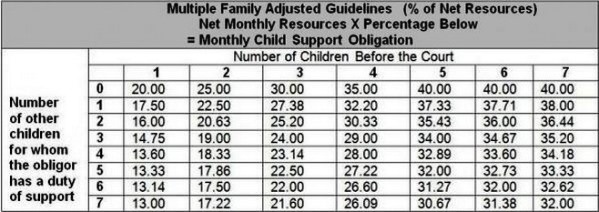
Net resources are determined by deducting the following from the obligor’s income:
1. Social Security Taxes;
2. Federal Income Tax based on the tax rate for a single person claiming one personal exemption and the standard deductions;
3. State Income Tax;
4. Union Dues (if such deductions are being withheld); and
5. Expenses for Health Insurance Coverage for Obligor’s Child(ren) (if such deductions are being withheld).
See Texas Child Support Infographic , provided by Dallas Texas Attorney Mark Nacol, of the Nacol Law Firm PC
NACOL LAW FIRM P.C.
8144 Walnut Hill Lane
Suite 1190
Dallas, Texas 75231
972-690-3333
Office Hours
Monday – Thursday, 8am – 5pm
Friday, 8:30am – 5pm
OUR BLOGS

SEARCH
JOIN OUR NETWORK

Attorney Mark A. Nacol is board certified in Civil Trial Law by the Texas Board of Legal Specialization