Big Changes in Texas Spousal Maintenance Laws

February 7th, 2012

Texas House Bill 901 changing the spousal maintenance law in the Texas Family Code became effective for divorce cases filed on or after September 1, 2011. The bill revises the conditions that establish eligibility for spousal maintenance, commonly referred to as alimony, and changes the factors required to be considered by a court in determining the nature, amount, duration, and manner of periodic payments for a spouse who is eligible to receive maintenance.

Eligibility for spousal maintenance requires that the spouse seeking maintenance lack sufficient property to provide for the spouse’s minimum reasonable needs.

The new law provides potentially increased relief to spouses who have been out of the work force, are disabled, are victims of family violence or are the primary custodians of a disabled child.

Major changes to the Texas spousal support law are:

1. The maximum amount of spousal support that courts may award increased from $2,500 to $5,000.00 per month, although still limited to 20 percent of the payer’s average gross monthly income.

2. The duration of spousal support extended from a maximum of 3 years to a maximum of 5, 7 or 10 years, generally depending on the length of the marriage.

3. The law clarified that if a person has primary care for a disabled child, the custodial parent may be prevented because of the child’s disability from earning sufficient income to meet the custodial parent’s minimum reasonable needs.

4. The law also clarified that a person may not be held in contempt for failing to pay spousal support which is in an agreed order and extends beyond the period of time provided under the law.

In order to receive “maintenance,” (which is the statutory term for spousal support), the spouse seeking support must lack sufficient property to provide for the spouse’s “minimum reasonable needs”, AND one of the following:

(1) The recipient must be unable to earn sufficient income to provide for his or her minimum reasonable needs because of an incapacitating mental or physical disability;

(2) The marriage lasted for 10 years or longer and the recipient lacks the ability to earn sufficient income to provide for his or her minimum reasonable needs;

(3) The recipient is the custodian of a child of the marriage of any age who requires substantial care and personal supervision because of a physical or mental disability that prevents the spouse from earning sufficient income to provide for the spouse’s minimum reasonable needs; OR

(4) The person ordered to pay support was convicted of or received deferred jurisdiction for an act of family violence during the pendency of the suit or within two years of the date the suit is filed.

Under the previous law, under most circumstances, the court could only order maintenance for a maximum of three years, regardless of the length of the marriage. Under the new law, the court can order maintenance to continue for:

(1) 5 years if the parties were married less than 10 years and the maintenance is awarded due to family violence;

(2) 5 years if the parties were married more than 10 years, but less than 20 years.

(3) 7 years if the parties were married more than 20 years, but less than 30 years;

(4) 10 years if the parties were married for more than 30 years.

In cases where the maintenance is awarded due to the mental or physical disability of the spouse or a child of the marriage, the court may order that the maintenance continue as long as the disability continues.

However, in all circumstances, the law provides that the Court shall order maintenance for the shortest reasonable period that allows the recipient to earn sufficient income to meet his or her reasonable needs.

If you are contemplating dissolving your marriage and have questions concerning your financial future, seek competent legal counsel to help you determine whether you could be eligible for spousal support under the expanded provisions of the new law.

Texas Child Support Guidelines

January 4th, 2012

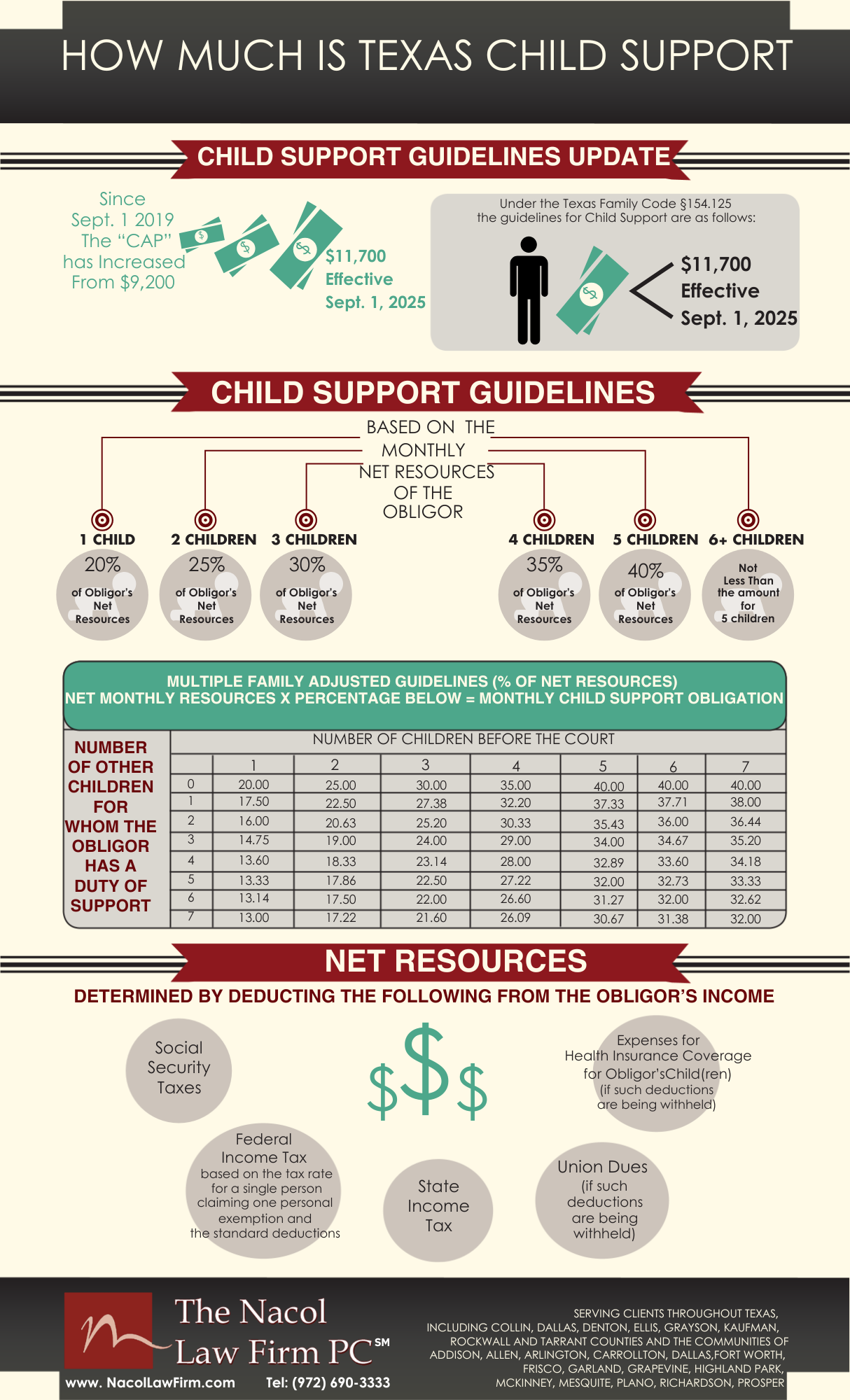
Under the Texas Family Code §154.125 the guidelines for child support are as follows:


(a) The guidelines for the support of a child in this section are specifically designed to apply to situations in which the obligor’s monthly net resources are not greater than $7,500 or the adjusted amount determined under Subsection (a-1), whichever is greater.


(a-1)  The dollar amount prescribed by Subsection (a) above is adjusted every six years as necessary to reflect inflation.  The Title IV-D agency shall compute the adjusted amount, to take effect beginning September 1 of the year of the adjustment, based on the percentage change in the consumer price index during the 72-month period preceding March 1 of the year of the adjustment, as rounded to the nearest $50 increment.  The Title IV-D agency shall publish the adjusted amount in the Texas Register before September 1 of the year in which the adjustment takes effect.  For purposes of this subsection, “consumer price index” has the meaning assigned by Section 341.201, Finance Code.


(a-2)  The initial adjustment required by Subsection (a-1) shall take effect September 1, 2013.  This subsection expires September 1, 2014.


(b)        if the obligor’s monthly net resources are not greater than the amount provided by Subsection (a), the court shall presumptively apply the following schedule in rendering the child support order: 


CHILD SUPPORT GUIDELINES

BASED ON THE MONTHLY NET RESOURCES OF THE OBLIGOR


1 child              20% of Obligor’s Net Resources

2 children          25% of Obligor’s Net Resources

3 children          30% of Obligor’s Net Resources

4 children          35% of Obligor’s Net Resources

5 children          40% of Obligor’s Net Resources

         6+ children        Not less than the amount for 5 children


Depending on the number of other children an obligor has a duty to support, the percentage of child support may be lower.  For example, if the obligor was previously married and has 1 child to support in the previous marriage, the amount of support paid for one child before the court decreases to 17.50 percent.  See the chart below.


Multiple Family Adjusted Guidelines

(% of Net Resources)

Net Monthly Resources X Percentage Below = Monthly Child Support Obligation


Number of other children for whom the obligor has a duty of support

Number of Children Before the Court


1

2

3

4

5

6

7

0

20.00

25.00

30.00

35.00

40.00

40.00

40.00

1

17.50

22.50

27.38

32.20

37.33

37.71

38.00

2

16.00

20.63

25.20

30.33

35.43

36.00

36.44

3

14.75

19.00

24.00

29.00

34.00

34.67

35.20

4

13.60

18.33

23.14

28.00

32.89

33.60

34.18

5

13.33

17.86

22.50

27.22

32.00

32.73

33.33

6

13.14

17.50

22.00

26.60

31.27

32.00

32.62

7

13.00

17.22

21.60

26.09

30.67

31.38

32.00


Net resources are determined by deducting the following from the obligor’s income:


1.             Social Security Taxes;

2.             Federal Income Tax based on the tax rate for a single person claiming one personal exemption and the standard deductions;

3.             State Income Tax;

4.             Union Dues (if such deductions are being withheld); and

5.             Expenses for Health Insurance Coverage for Obligor’s Child(ren) (if such deductions are being withheld).

His, Hers, Ours: Marriage, Divorce, Remarriage

June 27th, 2011

Today’s family unit is often in a state of flux.  After a divorce, most people remarry and often there are children involved.  In the new, blended family, one or both spouses may be paying child support.  Newly-born or adopted children may also enter into the picture.

Sometimes, the cycle continues:  marriage, divorce, remarriage, divorce. 

Now, mom or dad has children in multiple households.

Do the additional children change the amount of child support to be paid?  Not without a court order. 

In Texas, child support may be reduced when an obligor (person paying child support) has additional children that the obligor is legally required to support.  These children may be new biological children, or legally adopted children.  Generally, Texas courts do not consider stepchildren as a factor in reducing child support.

Texas courts follow statutory guidelines in determining amount of child support.  Many people are familiar with the following basic formula:  20% of net income for one child; 25% of net income for two children; 30% of net income for three children; and so on.

However, under the legal guidelines, the court also considers whether the obligor has a legal obligation to support other children, either under another child support order or because the obligor has legal custody of the child.  In cases involving the children in multiple households, the court may consult the following chart from Section 154.129 of the Texas Family Code:

CHILD SUPPORT GUIDELINES

BASED ON THE MONTHLY NET RESOURCES OF THE OBLIGOR


1 child 20% of Obligor’s Net Resources

2 children 25% of Obligor’s Net Resources

3 children 30% of Obligor’s Net Resources

4 children 35% of Obligor’s Net Resources

5 children 40% of Obligor’s Net Resources

6+ children Not less than the amount for 5 children


Depending on the number of other children an obligor has a duty to support, the percentage of child support may be lower. For example, if the obligor was previously married and has 1 child to support in the previous marriage, the amount of support paid for one child before the court decreases to 17.50 percent. See the chart below.


Multiple Family Adjusted Guidelines

(% of Net Resources)

Net Monthly Resources X Percentage Below = Monthly Child Support Obligation


Number of other children for whom the obligor has a duty of support

Number of Children Before the Court


1

2

3

4

5

6

7

0

20.00

25.00

30.00

35.00

40.00

40.00

40.00

1

17.50

22.50

27.38

32.20

37.33

37.71

38.00

2

16.00

20.63

25.20

30.33

35.43

36.00

36.44

3

14.75

19.00

24.00

29.00

34.00

34.67

35.20

4

13.60

18.33

23.14

28.00

32.89

33.60

34.18

5

13.33

17.86

22.50

27.22

32.00

32.73

33.33

6

13.14

17.50

22.00

26.60

31.27

32.00

32.62

7

13.00

17.22

21.60

26.09

30.67

31.38

32.00

The court may also consider additional factors listed in Section 154.123 of the Texas Family Code. 

In order to benefit from these factors, the obligor must present evidence that rebuts the presumption that the statutory guidelines is in the best interest of the children.  When a person has children in more than one household, determining child support can be complicated.  A wise person will seek the professional help of an experienced family law attorney.

Serving clients throughout Texas, including Collin, Dallas, Denton, Ellis, Grayson, Kaufman, Rockwall and Tarrant counties and the communities of Addison, Allen, Arlington, Carrollton, Dallas, Fort Worth, Frisco, Garland, Grapevine, Highland Park, McKinney, Mesquite, Plano, Richardson, Rowlett and University Park, Murphy,Wylie, Lewisville, Flower Mound, Irving, along with surrounding DFW areas.