Texas Child Support Guidelines

January 4th, 2012

Under the Texas Family Code §154.125 the guidelines for child support are as follows:


(a) The guidelines for the support of a child in this section are specifically designed to apply to situations in which the obligor’s monthly net resources are not greater than $7,500 or the adjusted amount determined under Subsection (a-1), whichever is greater.


(a-1)  The dollar amount prescribed by Subsection (a) above is adjusted every six years as necessary to reflect inflation.  The Title IV-D agency shall compute the adjusted amount, to take effect beginning September 1 of the year of the adjustment, based on the percentage change in the consumer price index during the 72-month period preceding March 1 of the year of the adjustment, as rounded to the nearest $50 increment.  The Title IV-D agency shall publish the adjusted amount in the Texas Register before September 1 of the year in which the adjustment takes effect.  For purposes of this subsection, “consumer price index” has the meaning assigned by Section 341.201, Finance Code.


(a-2)  The initial adjustment required by Subsection (a-1) shall take effect September 1, 2013.  This subsection expires September 1, 2014.


(b)        if the obligor’s monthly net resources are not greater than the amount provided by Subsection (a), the court shall presumptively apply the following schedule in rendering the child support order: 


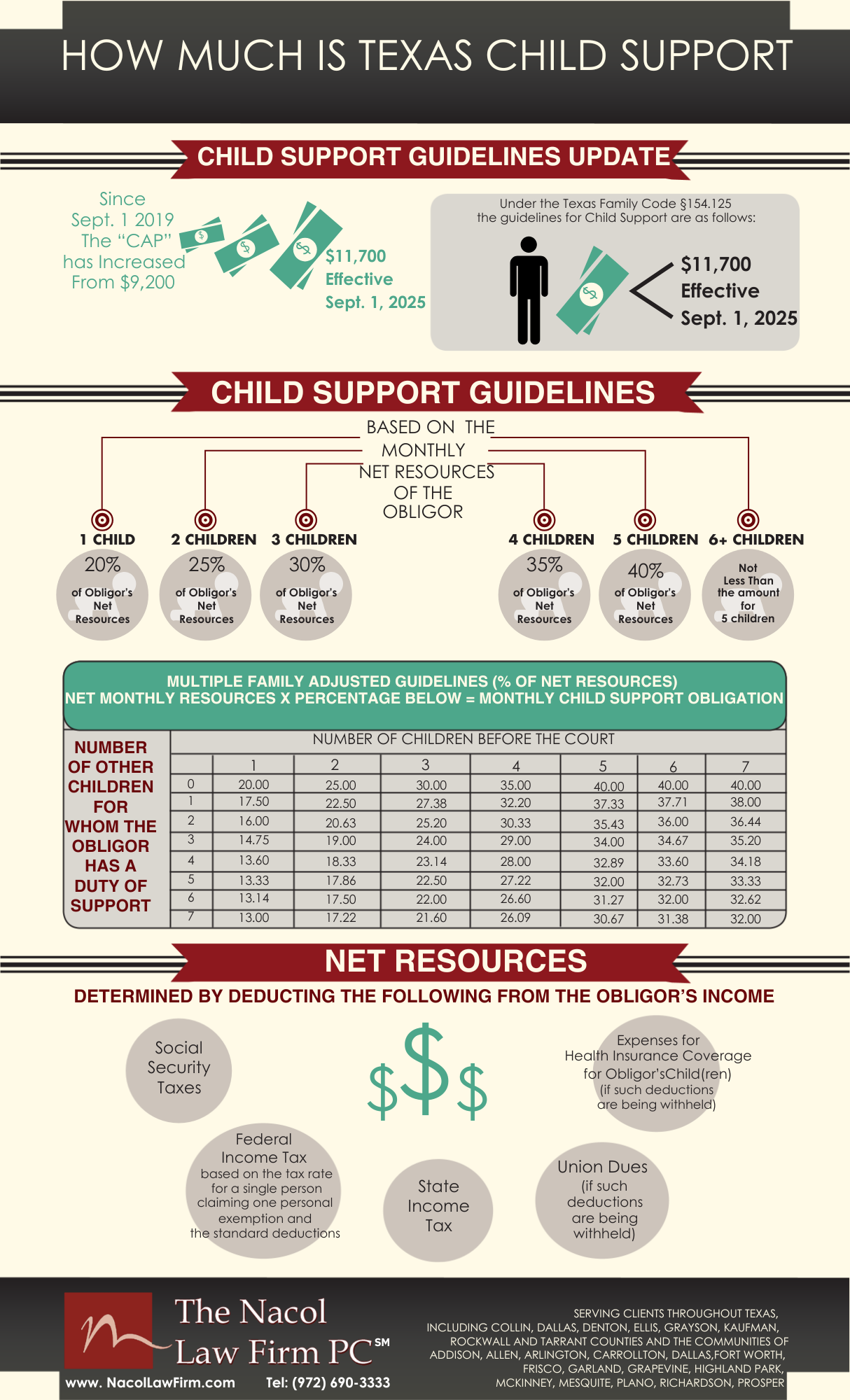
CHILD SUPPORT GUIDELINES

BASED ON THE MONTHLY NET RESOURCES OF THE OBLIGOR


1 child              20% of Obligor’s Net Resources

2 children          25% of Obligor’s Net Resources

3 children          30% of Obligor’s Net Resources

4 children          35% of Obligor’s Net Resources

5 children          40% of Obligor’s Net Resources

         6+ children        Not less than the amount for 5 children


Depending on the number of other children an obligor has a duty to support, the percentage of child support may be lower.  For example, if the obligor was previously married and has 1 child to support in the previous marriage, the amount of support paid for one child before the court decreases to 17.50 percent.  See the chart below.


Multiple Family Adjusted Guidelines

(% of Net Resources)

Net Monthly Resources X Percentage Below = Monthly Child Support Obligation


Number of other children for whom the obligor has a duty of support

Number of Children Before the Court


1

2

3

4

5

6

7

0

20.00

25.00

30.00

35.00

40.00

40.00

40.00

1

17.50

22.50

27.38

32.20

37.33

37.71

38.00

2

16.00

20.63

25.20

30.33

35.43

36.00

36.44

3

14.75

19.00

24.00

29.00

34.00

34.67

35.20

4

13.60

18.33

23.14

28.00

32.89

33.60

34.18

5

13.33

17.86

22.50

27.22

32.00

32.73

33.33

6

13.14

17.50

22.00

26.60

31.27

32.00

32.62

7

13.00

17.22

21.60

26.09

30.67

31.38

32.00


Net resources are determined by deducting the following from the obligor’s income:


1.             Social Security Taxes;

2.             Federal Income Tax based on the tax rate for a single person claiming one personal exemption and the standard deductions;

3.             State Income Tax;

4.             Union Dues (if such deductions are being withheld); and

5.             Expenses for Health Insurance Coverage for Obligor’s Child(ren) (if such deductions are being withheld).

His, Hers, Ours: Marriage, Divorce, Remarriage

June 27th, 2011

Today’s family unit is often in a state of flux.  After a divorce, most people remarry and often there are children involved.  In the new, blended family, one or both spouses may be paying child support.  Newly-born or adopted children may also enter into the picture.

Sometimes, the cycle continues:  marriage, divorce, remarriage, divorce. 

Now, mom or dad has children in multiple households.

Do the additional children change the amount of child support to be paid?  Not without a court order. 

In Texas, child support may be reduced when an obligor (person paying child support) has additional children that the obligor is legally required to support.  These children may be new biological children, or legally adopted children.  Generally, Texas courts do not consider stepchildren as a factor in reducing child support.

Texas courts follow statutory guidelines in determining amount of child support.  Many people are familiar with the following basic formula:  20% of net income for one child; 25% of net income for two children; 30% of net income for three children; and so on.

However, under the legal guidelines, the court also considers whether the obligor has a legal obligation to support other children, either under another child support order or because the obligor has legal custody of the child.  In cases involving the children in multiple households, the court may consult the following chart from Section 154.129 of the Texas Family Code:

CHILD SUPPORT GUIDELINES

BASED ON THE MONTHLY NET RESOURCES OF THE OBLIGOR


1 child 20% of Obligor’s Net Resources

2 children 25% of Obligor’s Net Resources

3 children 30% of Obligor’s Net Resources

4 children 35% of Obligor’s Net Resources

5 children 40% of Obligor’s Net Resources

6+ children Not less than the amount for 5 children


Depending on the number of other children an obligor has a duty to support, the percentage of child support may be lower. For example, if the obligor was previously married and has 1 child to support in the previous marriage, the amount of support paid for one child before the court decreases to 17.50 percent. See the chart below.


Multiple Family Adjusted Guidelines

(% of Net Resources)

Net Monthly Resources X Percentage Below = Monthly Child Support Obligation


Number of other children for whom the obligor has a duty of support

Number of Children Before the Court


1

2

3

4

5

6

7

0

20.00

25.00

30.00

35.00

40.00

40.00

40.00

1

17.50

22.50

27.38

32.20

37.33

37.71

38.00

2

16.00

20.63

25.20

30.33

35.43

36.00

36.44

3

14.75

19.00

24.00

29.00

34.00

34.67

35.20

4

13.60

18.33

23.14

28.00

32.89

33.60

34.18

5

13.33

17.86

22.50

27.22

32.00

32.73

33.33

6

13.14

17.50

22.00

26.60

31.27

32.00

32.62

7

13.00

17.22

21.60

26.09

30.67

31.38

32.00

The court may also consider additional factors listed in Section 154.123 of the Texas Family Code. 

In order to benefit from these factors, the obligor must present evidence that rebuts the presumption that the statutory guidelines is in the best interest of the children.  When a person has children in more than one household, determining child support can be complicated.  A wise person will seek the professional help of an experienced family law attorney.

Texas Divorce / Texas Child Support Q and A

October 22nd, 2010

Q: How long is the divorce process?
A: In a Texas divorce there is a waiting period of a minimum of 60 days from the time you file the Original Petition commencing the lawsuit to the time the divorce may be finalized. Few divorces are finalized in this time-period.  It is more likely that an uncontested divorce will take approximately 3 to 6 months and a contested divorce will likely will take much longer depending on the issues and conduct of the parties.

Q: Do my spouse and I both have to hire attorneys?
A:  No. But it is certainly in your best interest to hire an attorney for a consultation purposes and to review legal documents for your own protection.  An attorney should not in the vast majority of cases represent both parties, so if one attorney is involved he or she will under law be looking out for the best interest of the client that hired him/her, while the other party is representing themselves (pro se).

Q: Will I have to go to court?
A: If the spouses reach agreement, one party will have to appear in Court.  Often times, when the parties have worked out their own settlement, that agreement is signed by each of you and submitted to the court with only one party making a personal appearance to state to the Court that the agreement has been reached and to establish statutory requirements. If, on the other hand, you and your spouse cannot come to an amicable settlement through this process, you will both have to appear in court, and often on many occasions.

Q:Should I Move Out of the Marital Residence?
A: Be sure to consult with an attorney before leaving the marital residence. Leaving the home may be viewed as abandonment or actually declaring a new residence, especially if you are taking personal items with you (clothing, automobile, sentimental possessions, etc.).  If children are involved issues may arise as to who currently has or should have primary possession of the children.  Once you have voluntarily left the home, it may be difficult to move back in or obtain orders for primary or temporary possession.

Q:How Do I Get a Divorce?
A: Before getting divorced you or you and your spouse should decide that you absolutely want and need the divorce. Even though in the divorce process prior to final judgment everything is reversible, it is important that you realize that the road is sometimes very long and can be a difficult one to travel.

Q:What if I Do Not Want a Divorce?
A: The advent of a divorce is something that slowly builds. You may want to consult with your spouse about placing things on hold while you receive counseling.  However, the need for a divorce is rarely something that happens over night. Your spouse may have made his or her mind up long ago that divorce is the only option.  If your spouse has filed for divorce, you have no choice.  The most important thing for you to do if your spouse has filed for divorce is promptly seek proper legal advice. 

If your spouse has significant assets and you feel they may be considering divorce seek legal advice immediately.  You may want to do some pre-planning to make sure you have complete copies of original and final documents and know where all the marital assets are located and to assure their status.  Do not give your spouse time to stash, spend away and/or hide assets.

Q:Can You Modify Child Support Orders?
A: Making changes to an existing child support order is not uncommon. Most states will not allow a request for modification on a child support order unless a time-period (of 2 to 4 years depending on the state) has passed since the order was put into place. Keep in mind that child support orders cannot be increased or decreased on a whim.  In Texas, you must show a change in circumstances.  However, if the person paying child support’s income has gone up or down more than 25% you can request a change.  IMPORTANT NOTE:  If you agree to no child support in your first order (Final Decree) and your spouse has a significant income at that time, you may have waived a statutory right to future child support unless the income level at the time of the existing order increases or decreases significantly.

Q:Can I Deny My Ex-spouse Visitation, Possession or Access?
A: You can not and should not deny visitation or possession, unless the Court has modified the visitation or possession to allow it! Denying visitation or possession is one of the biggest mistakes made by most primary custodial parents – it is an act of contempt in Texas. You may believe you have a justifiable reason for denying the visitation or possession rights, but by law your are not permitted to do so absent extraordinary circumstances, usually involving gross neglect or physical abuse.

Q:How Do I Get Custody of My Child(ren)?
A: The first and most important step to getting custody of your child(ren) is to be an involved and hands-on parent and to be honest. Being a great parent is not always the easiest task during divorce, but it is important to carefully consider each and every action you take during a divorce and how it may or may not effect the child(ren).  You will also need good legal representation.  Child custody issues can become ugly and complicated no matter how good your intentions may be.  Make sure you are prepared.  Document everything.

Q:What if I Do Not Like the Judges Decision?
A: The purpose of the ruling is to establish what exactly should be stated in the Final Divorce Decree. Once the attorneys have drafted the Final Divorce Decree and both parties have agreed that it coincides with the ruling, it will be presented to the Judge for signing.  Once the parties have agreed and signatures are signed, you will have to live with the decisions.  If the divorce is highly contested and the Judge rules and you are unhappy with the results, you have only a small window to appeal the decision or request a new trial. 

Q:What is Fair Spousal Support or Alimony?
A: If you and your spouse can not come to agreement on the need for or amount of spousal support to be paid, the length of time, and under what conditions, the spousal support will most likely be set by a Judge according to Texas law.  See our blog on  Texas Spousal Support – Post Divorce Maintenance for more information.

Serving clients throughout Texas, including Collin, Dallas, Denton, Ellis, Grayson, Kaufman, Rockwall and Tarrant counties and the communities of Addison, Allen, Arlington, Carrollton, Dallas, Fort Worth, Frisco, Garland, Grapevine, Highland Park, McKinney, Mesquite, Plano, Richardson, Rowlett and University Park, Murphy,Wylie, Lewisville, Flower Mound, Irving, along with surrounding DFW areas.